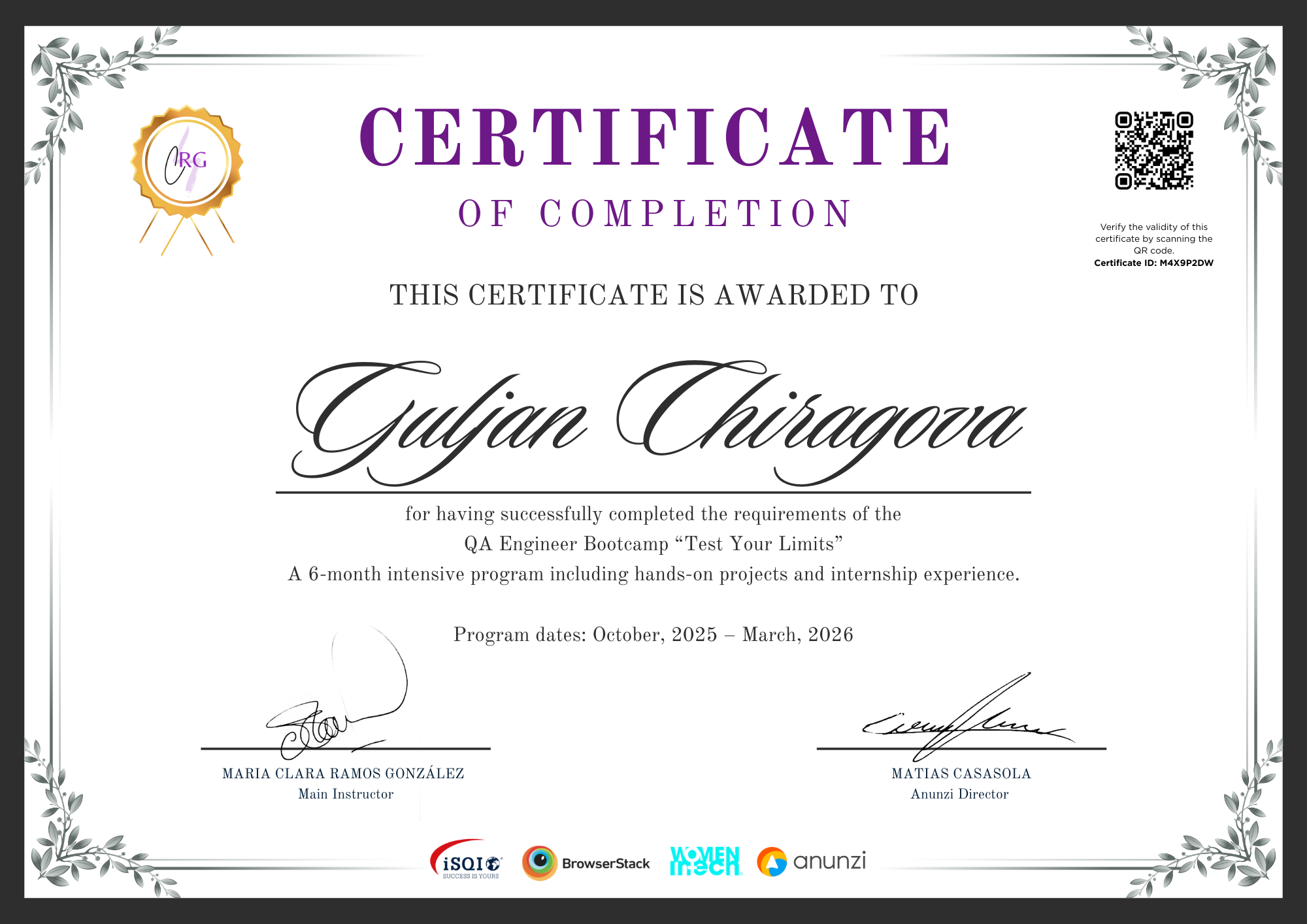
This certificate can be verified using the unique Certificate ID shown on the document.
To verify, match the student name, program dates, and Certificate ID on this page.
Certificate ID: M4X9P2DW
Student Name: Guljan Chiragova
Program dates: October 2025 – March 2026.
Status: Valid
Theory learned
- QA Engineer role in product teams; QA roles/titles and career paths
- ISTQB CTFL fundamentals: purpose + exam format; core testing principles; test closure/sign-off mindset
- SDLC overview; software management goals; Waterfall vs Agile; methodology/model vs framework
- Scrum (ceremonies, sprints, refinement), Kanban (flow, WIP), XP practices (TDD, CI, refactoring, pair programming, etc.), hybrid approaches
- Testing vs QA/QE; STLC activities across lifecycle; regulated/compliance-driven QA concepts
- Testing environments (local/DEV/QA/Staging/UAT/Prod) + post-release validation; cache/cookies impacts
- Manual testing foundations: black-box/white-box/gray-box; when manual vs automation; exploratory mindset
- Automation testing foundations: static vs dynamic testing; reviews + static analysis; what/how/when to automate; frameworks vs tools; low-code/no-code; CI/CD alignment; limitations
- Testing levels (unit, integration, system, system integration, acceptance) and test types (functional vs non-functional)
- Change-related testing: confirmation (re-test), regression testing, impact analysis
- Test design techniques: Equivalence Partitioning (EP), Boundary Value Analysis (BVA), decision tables, state transitions; white-box coverage (statement/branch); experience-based (exploratory, error guessing, checklist)
- Test documentation: test plan, test suite, test cases; Gherkin/BDD (Given–When–Then); regression planning and prioritization
- Defect management: error/defect/failure; defect lifecycle; root-cause thinking; defect metrics (density, severity distribution, leakage/escape, DRE, reopen rate, MTTD/MTTR, etc.)
- ALM fundamentals and why it matters; Jira vs Confluence roles in delivery governance and traceability
- Backend testing foundations: databases/DBMS; relational vs NoSQL; SQL basics; CRUD; constraints (PK/FK/UNIQUE/NOT NULL/CHECK/DEFAULT); ACID; DB performance risk awareness
- API testing foundations: REST, endpoints/resources, HTTP methods, requests/responses, headers/params/body, JSON; API types; API key/credential security awareness
- Non-functional testing foundations: responsive/mobile/cross-device; security awareness (phishing); performance testing types (load/stress/spike/soak/scalability) + key metrics
- Career development: LinkedIn profile structure, core values, elevator pitch (Past–Present–Future), networking/job search and Boolean logic
- AI in testing: LLM/GenAI basics (tokens, embeddings, context windows, non-determinism, multimodal); agents vs agentic AI; using AI across the test lifecycle; testing AI risks (hallucinations, bias, long-context degradation)
Skills acquired
- QA / Quality Engineering mindset (quality ownership, shift-left prevention, risk-based thinking, user-centric validation, evidence-based decisions)
- Manual testing execution using black-box testing, white-box testing, and gray-box testing, plus exploratory testing and checklist-based testing
- Test design with Equivalence Partitioning, Boundary Value Analysis, Decision Table Testing, State Transition Testing, Statement Testing, Branch Testing, and Error Guessing
- Testing strategy selection by testing levels (component/unit, integration, system, system integration, acceptance) and test types (functional and non-functional), including confirmation testing (re-testing fixes) and regression testing
- Professional test documentation: Test Plans, Test Suites, Test Cases, and Gherkin / Behavior-Driven Development (Given–When–Then) for clear, automation-ready scenarios
- Defect management: high-quality bug reporting (steps, expected vs actual, environment, severity/priority, evidence) + defect lifecycle handling and defect metrics interpretation
- Automation fundamentals: deciding what to automate, exposure to unit testing, integration testing, API testing, user interface testing, smoke testing, regression testing, and CI/CD execution mindset
- API integration testing: REST requests (GET/POST/PUT/DELETE), headers/params/body, JSON validation, collections/runs, basic assertions
- Backend testing with Structured Query Language: querying/filtering + CRUD validation, integrity via constraints (Primary Key, Foreign Key, Unique, Not Null, Check, Default) and ACID awareness
- Non-functional readiness: responsive and cross-device testing, baseline security awareness (phishing/credential hygiene), and performance testing literacy (load testing, stress testing, spike testing, endurance (soak) testing, scalability testing)
- ALM delivery workflows: traceability, dashboards/filters/queries, documentation, QA sign-off and post-deployment verification readiness
- AI-enabled QA productivity: GenAI for test cases/data/analysis/reporting, understanding reliability limits (context windows, non-determinism, hallucinations), plus agents vs agentic AI awareness
- Career readiness: LinkedIn optimization, elevator pitch, interview practice, targeted job search and networking execution
Practice executed
- Internship at Anunzi (https://ai.anunzi.net/) working on digital marketing and artificial intelligence projects
- VPN-based geo testing comparison exercises
- Kanban board creation and evidence submission
- Timeboxed bug-hunting challenges and exploratory testing sessions
- Manual testing mini-labs (UI measurement/alignment checks; Lighthouse audits; console/network diagnostics)
- Static analysis/code-quality check workflow (generate/update code → repo upload/commit → scan)
- Low-code automation recording, organizing, and executing an end-to-end flow
- Age validation labs applying EP/BVA/decision tables/state transitions
- Test plan/suite/case writing using templates; Gherkin-style test writing
- AI-assisted test case generation comparisons and refinement exercises
- Regression documentation and execution logging (Pass/Fail/NA) with evidence uploads
- Jira defect reporting labs + peer review of bug reports
- Defect metrics calculation and interpretation exercises
- Jira filtering (basic + JQL), saved filters, and personal dashboard setup
- SQL query + CRUD practice and filtering exercises
- API testing labs (GET/POST/PUT/DELETE), collections, runner execution, scripted assertions
- Cross-device/mobile bug hunting + security awareness activities (phishing/password strength)
- Career drills (values, elevator pitch, LinkedIn optimization, interview rehearsal)
- AI tooling exercises (tokenization, prompt variation, multimodal extraction, test-case generation and UI bug detection via extensions)
Tools and Plugins used during training
- Browser & evidence: Chrome DevTools, Lighthouse, Screenpresso
- Browser extensions/plugins: Page Ruler, WhatFont, Awesome Screenshot, CSS Viewer, UI Bug Detector, Testers.AI (test case generator)
- VPN: Hotspot Shield, Proton VPN
- Work management / ALM: Jira, JQL, Confluence
- Boards / learning interactions: Trello, Genially, Miro
- Automation & quality tooling: BrowserStack (incl. Low-Code), BrowserStack Code Quality Check, v0.app, GitHub
- API testing: Postman, Postman Collection Runner, Postbot, ReqRes API
- Databases / SQL: SQLSandboxes, SQLiteOnline
- Cross-device / responsive: BrowserStack, Sauce Labs, LambdaTest, TestGrid, Selenium Grid, Responsively App
- Security awareness resources: passwordmonster.com, phishingquiz.withgoogle.com, purposegames.com
- AI tools: ChatGPT, LM Arena, Tokenizer Playground
- Practice platforms/apps: practicesoftwaretesting.com, Age Validation practice page, Cars Game site, Anunzi platform/portal, Wikipedia (practice target)
- Other tools mentioned (exposure): Selenium, WebdriverIO, Cypress, Playwright, Appium; Cucumber; JUnit/NUnit/TestNG/PyTest/PHPUnit; Jenkins, GitHub Actions, Azure DevOps; OWASP ZAP, Burp Suite, Nessus, Acunetix; JMeter, LoadRunner, K6, Gatling, LoadNinja; Loop11, Crazy Egg, UserZoom; Grafana
- Career: LinkedIn, Slack, YouTube